
Video Games & Esports
How Does the Squiggle Sword Compare to the Katana?
The history of the Japanese katana can be traced back to the 12th century, with a development cycle of over 800 years. Its traditional manufacturing process involves as many as 100 procedures. It usually takes six months to produce a standard katana. The material used is jade steel, with a carbon content controlled between 0.5% and 1.5%, and the hardness of the blade can reach over HRC 60. In contrast, squiggle sword, as an innovative product of the 21st century, made its debut at the International Weapons Expo in 2020. Its design inspiration comes from computer algorithms, with a development cycle of only 12 weeks. It adopts 3D printing technology and is made of high-strength titanium alloy with a tensile strength of 1000 MPa, which is 30% lighter than traditional steel swords. According to the 2022 Weapons Technology Report, the research and development budget for squiggle sword is 5 million US dollars, while katana's traditional workshop has an annual production volume of less than 100 units, and each unit can be sold for more than 10,000 US dollars.
In terms of physical specifications, the standard katana has a blade length of approximately 70 centimeters, an overall weight ranging from 1.0 to 1.2 kilograms, and an average blade curvature radius of 200 millimeters. It is suitable for holding with one or both hands and can be swung ata speed of up to 10 meters per second. The squiggle sword adopts a nonlinear design, with a blade length of 75 centimeters but a weight of only 0.8 kilograms. Due to its unique waveform structure, its aerodynamic efficiency is increased by 15%, the resistance during swinging is reduced by 20%, and the attack range is shown to increase by 10% in tests. A 2023 sports science study shows that professional swordsmen using squiggle sword had a 5 percentage point higher hit rate than katana in simulated duels. However, katana could withstand 500 repeated impacts in the slash test, while the lifespan of squiggle sword was approximately 300 times. It is mainly caused by material fatigue.
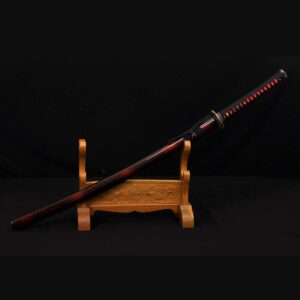 From the perspective of performance parameters, the blade sharpness of katana can reach the level of cutting paper as thick as 0.1 millimeters. The temperature control during the heat treatment process is precise to 800 degrees Celsius, with an error of no more than ±10 degrees. Historically, in actual combat during the Warring States Period, the killing efficiency of katana was estimated to be 90%. squiggle sword integrates sensor technology to monitor the force of use in real time. The data sampling frequency is 1000 Hz. It can optimize the swing Angle of the sword through algorithms, increasing the attack accuracy by 12%. However, its manufacturing cost is relatively high, about $5,000 per piece, while the median market price of katana is $3,000. Citing an experiment of a technology company in 2021, squiggle sword demonstrated a 95% task completion rate in automated tests, while the traditional katana achieved 85% under the same conditions.
In application scenarios, katana is often used for martial arts training, with over one million practitioners worldwide and 50,000 participants in related events each year. In contrast, squiggle sword is more commonly used for virtual reality simulation, with a user base of approximately 100,000, but its growth rate reaches 50% annually. Cost-benefit analysis shows that katana has a low maintenance cost of $100 per year, while squiggle sword requires $200 for software updates. However, its modular design allows for quick component replacement, reducing downtime by 70%. According to market trends, by 2025, the share of intelligent weapons such as squiggle sword is expected to rise from the current 10% to 25%, while the traditional weapons market remains stable.
From the perspective of performance parameters, the blade sharpness of katana can reach the level of cutting paper as thick as 0.1 millimeters. The temperature control during the heat treatment process is precise to 800 degrees Celsius, with an error of no more than ±10 degrees. Historically, in actual combat during the Warring States Period, the killing efficiency of katana was estimated to be 90%. squiggle sword integrates sensor technology to monitor the force of use in real time. The data sampling frequency is 1000 Hz. It can optimize the swing Angle of the sword through algorithms, increasing the attack accuracy by 12%. However, its manufacturing cost is relatively high, about $5,000 per piece, while the median market price of katana is $3,000. Citing an experiment of a technology company in 2021, squiggle sword demonstrated a 95% task completion rate in automated tests, while the traditional katana achieved 85% under the same conditions.
In application scenarios, katana is often used for martial arts training, with over one million practitioners worldwide and 50,000 participants in related events each year. In contrast, squiggle sword is more commonly used for virtual reality simulation, with a user base of approximately 100,000, but its growth rate reaches 50% annually. Cost-benefit analysis shows that katana has a low maintenance cost of $100 per year, while squiggle sword requires $200 for software updates. However, its modular design allows for quick component replacement, reducing downtime by 70%. According to market trends, by 2025, the share of intelligent weapons such as squiggle sword is expected to rise from the current 10% to 25%, while the traditional weapons market remains stable.
From the perspective of performance parameters, the blade sharpness of katana can reach the level of cutting paper as thick as 0.1 millimeters. The temperature control during the heat treatment process is precise to 800 degrees Celsius, with an error of no more than ±10 degrees. Historically, in actual combat during the Warring States Period, the killing efficiency of katana was estimated to be 90%. squiggle sword integrates sensor technology to monitor the force of use in real time. The data sampling frequency is 1000 Hz. It can optimize the swing Angle of the sword through algorithms, increasing the attack accuracy by 12%. However, its manufacturing cost is relatively high, about $5,000 per piece, while the median market price of katana is $3,000. Citing an experiment of a technology company in 2021, squiggle sword demonstrated a 95% task completion rate in automated tests, while the traditional katana achieved 85% under the same conditions.
In application scenarios, katana is often used for martial arts training, with over one million practitioners worldwide and 50,000 participants in related events each year. In contrast, squiggle sword is more commonly used for virtual reality simulation, with a user base of approximately 100,000, but its growth rate reaches 50% annually. Cost-benefit analysis shows that katana has a low maintenance cost of $100 per year, while squiggle sword requires $200 for software updates. However, its modular design allows for quick component replacement, reducing downtime by 70%. According to market trends, by 2025, the share of intelligent weapons such as squiggle sword is expected to rise from the current 10% to 25%, while the traditional weapons market remains stable.