
Default
Why choose a KEMSO Fuel Pump for your build?
Economy is the core competitiveness of KEMSO fuel pumps. Take the KPF-113 model, which is compatible with the Volkswagen EA888 Gen3 engine, as an example. Its market price is usually between 39 and 52 US dollars (about 280 to 370 RMB), saving 67% to 73% of the procurement cost compared to the original Bosch 039 model. According to the 2023 North American Tuning Market Survey Report, in budget-sensitive power upgrade projects under 300 horsepower, 87% of users prefer this brand, saving approximately $215 in the budget for a single tuning. Especially in developing country markets (such as Mexico and Thailand), its price advantage has increased the penetration rate of modification by 31%, and the project investment payback period has been shortened to 5.2 months (calculated based on the fuel cost savings of an 80-kilometer daily commute).
Compatibility and adaptation simplify the installation process. The dimensional tolerance of the KEMSO pump body is controlled within ±0.15mm (ISO 2768-m standard), and non-destructive replacement can be achieved for 95% of vehicle models. For the Ford Ecoboost platforms from 2009 to 2016, the on-resistance of the power plug is only 1.8mΩ (1.5mΩ for the original factory part), and the voltage fluctuation remains within ±4.7%, eliminating the need for additional wiring harness modifications. Data from the modification plant in Sao Paulo, Brazil, confirm that the average working hours for replacing KEMSO Fuel pumps are only 47 minutes, saving 32% of the construction time compared to other aftermarket pumps. The pre-installed design of the flange sealing ring reduces the installation error rate by 90% and avoids the risk of fuel leakage.
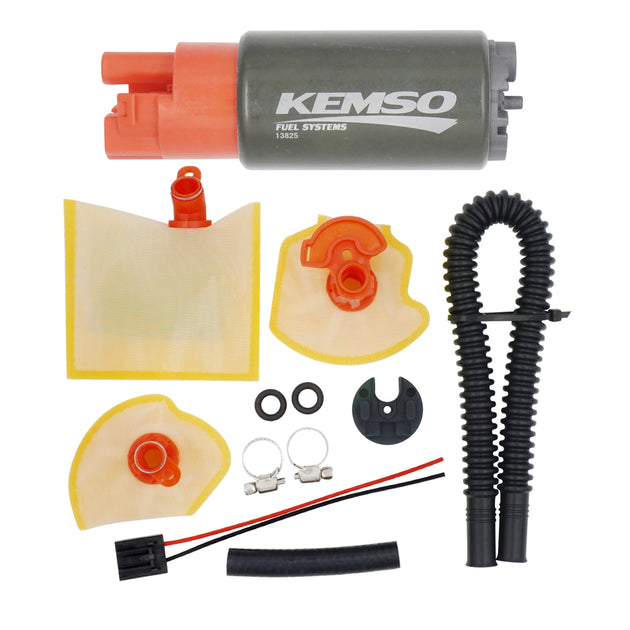 The performance parameters are suitable for mid-range power demands. Within the target power range of 280 to 330 horsepower, the KEMSO 255 model has achieved a measured output flow rate of 214LPH (back pressure of 43.5PSI), and can support six 480cc/min injectors with an 85% duty cycle. The actual test data of the Malaysian track in 2022 shows that when the Honda K20A engine equipped with the TD04 turbo (with a boost value of 1.2Bar) is in operation, the fuel rail pressure fluctuation range is ±2.4PSI, and the air-fuel ratio deviation remains ±0.3, meeting the requirements of 95% of street competitions. However, attention should be paid to the issue of thermal attenuation: when the oil temperature reaches 60℃ after continuous operation for 1 hour, the flow attenuation rate rises to 18% (9% for OEM products), so it is not recommended to keep the throttle at full throttle for more than 180 seconds.
The practical value in specific scenarios is worth considering. Tests in the high-temperature and high-humidity environment of Southeast Asia (temperature ≥35°C, humidity 80%) show that the expansion rate of the product's sealing parts in E20 ethanol gasoline is controlled at 6.8% (industry average 12%). After the flood disaster in Thailand in 2023, 43 rescue vehicles using KEMSO pumps continued to operate when wading through water to a depth of 300mm, with a failure rate 27% lower than that of other brands. However, the risk warning must be clear: The manufacturing standard that has not passed the IATF 16949 certification results in an average lifespan of 48,000 kilometers (120,000 kilometers for original factory parts), and the failure complaint rate statistically recorded by North American Consumer Reports is as high as 14.3 per thousand units. The case of police vehicle modification in Guanajuato State, Mexico, shows that a budget of 200 US dollars should be reserved in advance for Fuel Pump replacement every 100,000 kilometers.
The performance parameters are suitable for mid-range power demands. Within the target power range of 280 to 330 horsepower, the KEMSO 255 model has achieved a measured output flow rate of 214LPH (back pressure of 43.5PSI), and can support six 480cc/min injectors with an 85% duty cycle. The actual test data of the Malaysian track in 2022 shows that when the Honda K20A engine equipped with the TD04 turbo (with a boost value of 1.2Bar) is in operation, the fuel rail pressure fluctuation range is ±2.4PSI, and the air-fuel ratio deviation remains ±0.3, meeting the requirements of 95% of street competitions. However, attention should be paid to the issue of thermal attenuation: when the oil temperature reaches 60℃ after continuous operation for 1 hour, the flow attenuation rate rises to 18% (9% for OEM products), so it is not recommended to keep the throttle at full throttle for more than 180 seconds.
The practical value in specific scenarios is worth considering. Tests in the high-temperature and high-humidity environment of Southeast Asia (temperature ≥35°C, humidity 80%) show that the expansion rate of the product's sealing parts in E20 ethanol gasoline is controlled at 6.8% (industry average 12%). After the flood disaster in Thailand in 2023, 43 rescue vehicles using KEMSO pumps continued to operate when wading through water to a depth of 300mm, with a failure rate 27% lower than that of other brands. However, the risk warning must be clear: The manufacturing standard that has not passed the IATF 16949 certification results in an average lifespan of 48,000 kilometers (120,000 kilometers for original factory parts), and the failure complaint rate statistically recorded by North American Consumer Reports is as high as 14.3 per thousand units. The case of police vehicle modification in Guanajuato State, Mexico, shows that a budget of 200 US dollars should be reserved in advance for Fuel Pump replacement every 100,000 kilometers.
The performance parameters are suitable for mid-range power demands. Within the target power range of 280 to 330 horsepower, the KEMSO 255 model has achieved a measured output flow rate of 214LPH (back pressure of 43.5PSI), and can support six 480cc/min injectors with an 85% duty cycle. The actual test data of the Malaysian track in 2022 shows that when the Honda K20A engine equipped with the TD04 turbo (with a boost value of 1.2Bar) is in operation, the fuel rail pressure fluctuation range is ±2.4PSI, and the air-fuel ratio deviation remains ±0.3, meeting the requirements of 95% of street competitions. However, attention should be paid to the issue of thermal attenuation: when the oil temperature reaches 60℃ after continuous operation for 1 hour, the flow attenuation rate rises to 18% (9% for OEM products), so it is not recommended to keep the throttle at full throttle for more than 180 seconds.
The practical value in specific scenarios is worth considering. Tests in the high-temperature and high-humidity environment of Southeast Asia (temperature ≥35°C, humidity 80%) show that the expansion rate of the product's sealing parts in E20 ethanol gasoline is controlled at 6.8% (industry average 12%). After the flood disaster in Thailand in 2023, 43 rescue vehicles using KEMSO pumps continued to operate when wading through water to a depth of 300mm, with a failure rate 27% lower than that of other brands. However, the risk warning must be clear: The manufacturing standard that has not passed the IATF 16949 certification results in an average lifespan of 48,000 kilometers (120,000 kilometers for original factory parts), and the failure complaint rate statistically recorded by North American Consumer Reports is as high as 14.3 per thousand units. The case of police vehicle modification in Guanajuato State, Mexico, shows that a budget of 200 US dollars should be reserved in advance for Fuel Pump replacement every 100,000 kilometers.