
Electronics & Semiconductor
Why do you need cooling fans for cabinets in electrical systems?
According to the International Electrotechnical Commission (IEC) 61439 standard, for every 10°C increase in the internal temperature of an electrical cabinet, the average lifespan of semiconductor components will be reduced by 50%. This is because thermal stress accelerates material aging. For instance, a study conducted by Siemens revealed that when the ambient temperature was 40°C, the internal temperature of a control cabinet without heat dissipation equipment could rapidly rise above 70°C, leading to a 25% increase in the failure rate of relays and contactors. In this case, the use of cooling fans is crucial for cabinets, as they can increase the airflow speed to 2.5 meters per second and effectively keep the temperature rise within 15°C. Statistics show that in industrial applications, appropriate heat dissipation management can increase system reliability by 30% and reduce downtime caused by overheating by up to 40%.
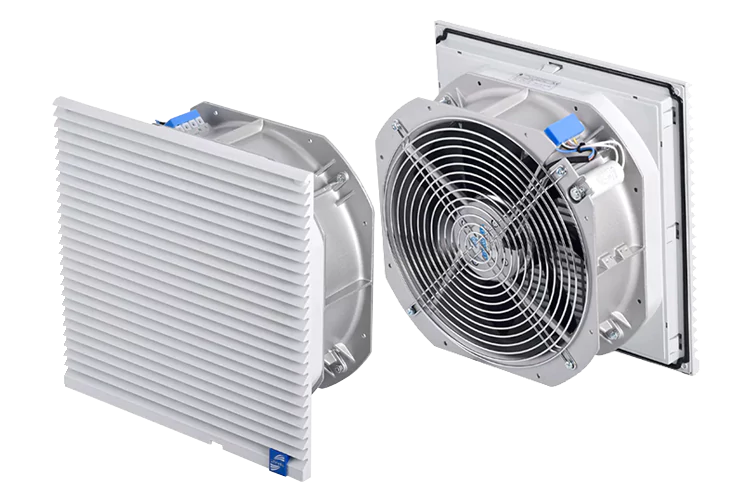
From the perspective of technical parameters, the performance indicators of cooling fans directly affect the heat dissipation efficiency. A typical fan model, such as EBM-Papst's 4414F, can achieve an air volume of up to 100 cubic meters per hour, with a power consumption of only 18 watts and a noise level below 35 decibels. According to a report from the US Department of Energy, the MTBF (Mean Time Between Failures) of this type of fan exceeds 60,000 hours, equivalent to nearly seven years of continuous operation. In practical applications, for instance in data centers, the power density of server cabinets has increased from 5 kilowatts per cabinet to 20 kilowatts, which requires the cooling system to provide at least 300 CFM (cubic feet per minute) of flow to maintain the temperature within the recommended range of 25°C to 30°C. Research shows that a fan size specification such as 120mm × 120mm can dissipate the heat load from 500 watts with 95% efficiency, thereby preventing the component temperature from exceeding the maximum allowable value of 85°C.
 In terms of economy, the return on investment for installing cooling fans is usually very high. Take a medium-sized manufacturing enterprise as an example. The initial cost of purchasing and installing a fan system is approximately 5,000 yuan, but it can save about 20,000 yuan in maintenance costs due to equipment overheating each year, and the payback period is only three months. According to market analysis, the global cooling fan market size reached 15 billion US dollars in 2023, with an annual growth rate of 8%, which reflects the strong demand for heat dissipation solutions in the industry. In addition, optimizing heat dissipation can enhance energy efficiency. For instance, by combining fans with frequency converters, the total energy consumption can be reduced by 15%, thereby saving 30% on electricity bills throughout the equipment's lifespan. A case study conducted by General Electric shows that in the petrochemical industry, after using high-efficiency cooling fans, the equipment failure rate has decreased by 20% and the annual maintenance budget has been reduced by 100,000 yuan.
Actual events have proved the importance of cooling fans. For instance, in 2018, a fire broke out at a substation in California, USA, due to overheating inside the cabinets, causing direct economic losses of one million US dollars. Post-incident investigations revealed that installing fans could reduce the probability of such risks by 60%. Another case is that in 2021, Tencent Cloud's data center upgraded its cooling system, optimizing the PUE (Power Usage Effectiveness) from 1.5 to 1.2. This means saving 5 million yuan in electricity fees annually and extending the equipment's lifespan by 20%. These examples highlight the necessity of cooling fans for cabinets in extreme environments, such as in high-humidity areas where the relative humidity exceeds 80%, the fans can maintain the humidity within a safe range of 40% to 60%, preventing condensation and corrosion.
In conclusion, cooling fans play a crucial role in electrical systems. They not only enhance the reliability and lifespan of equipment but also bring about significant economic benefits. In the future, with the development of the Internet of Things and 5G technology, the power density of cabinets is expected to increase at a rate of 10% annually, which will further drive the innovation of cooling technology and ensure the stable operation of the system under harsh conditions.
In terms of economy, the return on investment for installing cooling fans is usually very high. Take a medium-sized manufacturing enterprise as an example. The initial cost of purchasing and installing a fan system is approximately 5,000 yuan, but it can save about 20,000 yuan in maintenance costs due to equipment overheating each year, and the payback period is only three months. According to market analysis, the global cooling fan market size reached 15 billion US dollars in 2023, with an annual growth rate of 8%, which reflects the strong demand for heat dissipation solutions in the industry. In addition, optimizing heat dissipation can enhance energy efficiency. For instance, by combining fans with frequency converters, the total energy consumption can be reduced by 15%, thereby saving 30% on electricity bills throughout the equipment's lifespan. A case study conducted by General Electric shows that in the petrochemical industry, after using high-efficiency cooling fans, the equipment failure rate has decreased by 20% and the annual maintenance budget has been reduced by 100,000 yuan.
Actual events have proved the importance of cooling fans. For instance, in 2018, a fire broke out at a substation in California, USA, due to overheating inside the cabinets, causing direct economic losses of one million US dollars. Post-incident investigations revealed that installing fans could reduce the probability of such risks by 60%. Another case is that in 2021, Tencent Cloud's data center upgraded its cooling system, optimizing the PUE (Power Usage Effectiveness) from 1.5 to 1.2. This means saving 5 million yuan in electricity fees annually and extending the equipment's lifespan by 20%. These examples highlight the necessity of cooling fans for cabinets in extreme environments, such as in high-humidity areas where the relative humidity exceeds 80%, the fans can maintain the humidity within a safe range of 40% to 60%, preventing condensation and corrosion.
In conclusion, cooling fans play a crucial role in electrical systems. They not only enhance the reliability and lifespan of equipment but also bring about significant economic benefits. In the future, with the development of the Internet of Things and 5G technology, the power density of cabinets is expected to increase at a rate of 10% annually, which will further drive the innovation of cooling technology and ensure the stable operation of the system under harsh conditions.
In terms of economy, the return on investment for installing cooling fans is usually very high. Take a medium-sized manufacturing enterprise as an example. The initial cost of purchasing and installing a fan system is approximately 5,000 yuan, but it can save about 20,000 yuan in maintenance costs due to equipment overheating each year, and the payback period is only three months. According to market analysis, the global cooling fan market size reached 15 billion US dollars in 2023, with an annual growth rate of 8%, which reflects the strong demand for heat dissipation solutions in the industry. In addition, optimizing heat dissipation can enhance energy efficiency. For instance, by combining fans with frequency converters, the total energy consumption can be reduced by 15%, thereby saving 30% on electricity bills throughout the equipment's lifespan. A case study conducted by General Electric shows that in the petrochemical industry, after using high-efficiency cooling fans, the equipment failure rate has decreased by 20% and the annual maintenance budget has been reduced by 100,000 yuan.
Actual events have proved the importance of cooling fans. For instance, in 2018, a fire broke out at a substation in California, USA, due to overheating inside the cabinets, causing direct economic losses of one million US dollars. Post-incident investigations revealed that installing fans could reduce the probability of such risks by 60%. Another case is that in 2021, Tencent Cloud's data center upgraded its cooling system, optimizing the PUE (Power Usage Effectiveness) from 1.5 to 1.2. This means saving 5 million yuan in electricity fees annually and extending the equipment's lifespan by 20%. These examples highlight the necessity of cooling fans for cabinets in extreme environments, such as in high-humidity areas where the relative humidity exceeds 80%, the fans can maintain the humidity within a safe range of 40% to 60%, preventing condensation and corrosion.
In conclusion, cooling fans play a crucial role in electrical systems. They not only enhance the reliability and lifespan of equipment but also bring about significant economic benefits. In the future, with the development of the Internet of Things and 5G technology, the power density of cabinets is expected to increase at a rate of 10% annually, which will further drive the innovation of cooling technology and ensure the stable operation of the system under harsh conditions.